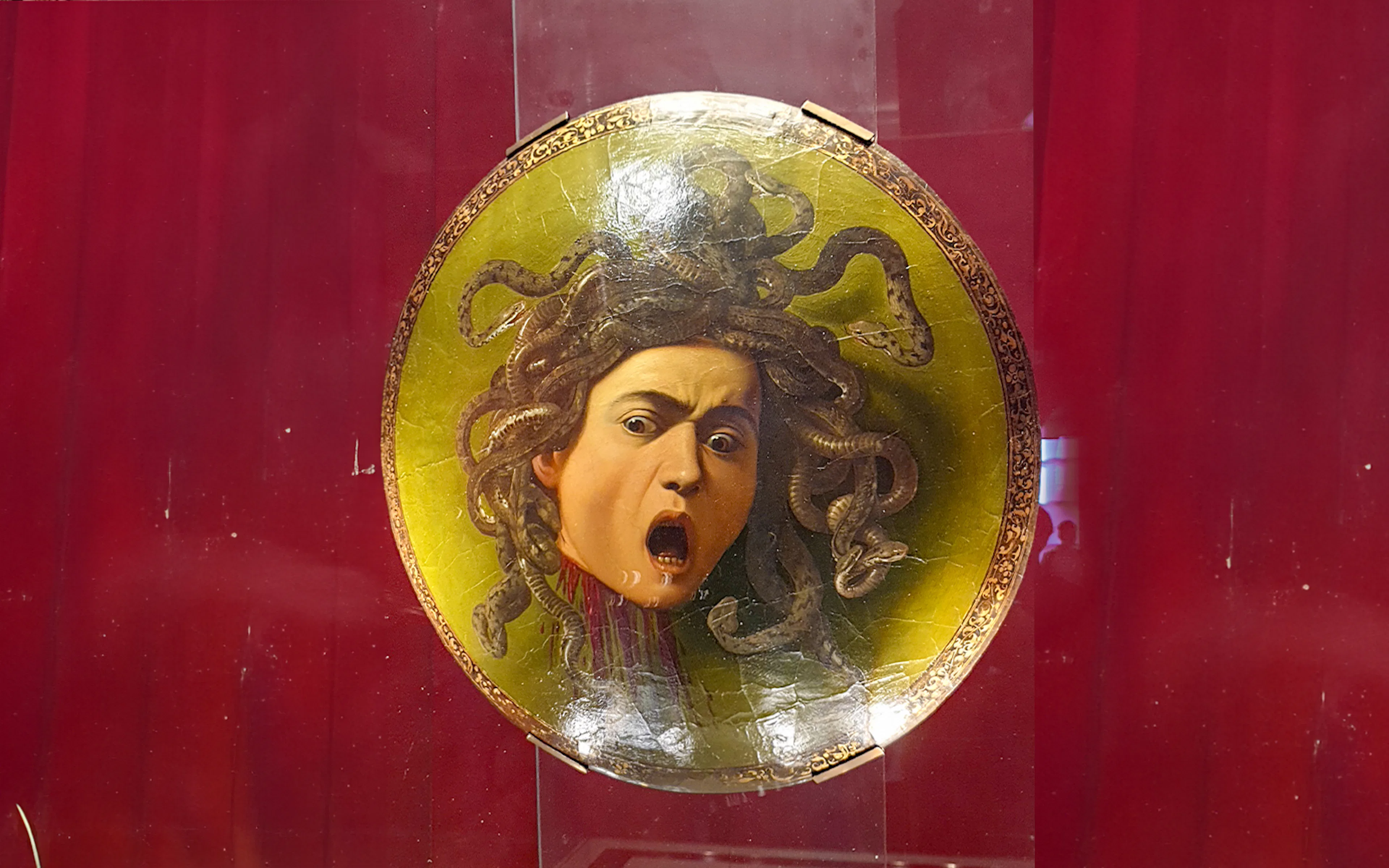
🛡️Caravaggio painted Medusa on a real wooden shield covered with canvas. This might be due to two possible reasons: one, to rival the original Medusa painting by Leonardo da Vinci (which unfortunately has never been retrieved). Two, to symbolise how Perseus slayed Medusa by using a shield to see her reflection, allowing him to sidestep her destructive gaze.
Baroque realism personified: Caravaggio’s Medusa
Caravaggio’s Medusa is unlike any other painting in Florence: it’s painted on a real ceremonial shield. Completed in 1597, the work captures the exact moment Medusa is beheaded, her eyes wide with shock, mouth frozen in a final scream, and snakes writhing around her head.
The shield was commissioned as a gift for the Medici family, and today it sits proudly in the Caravaggio Rooms on the first floor. Its haunting realism and daring innovation make it one of the most unforgettable works of Baroque art.
Where is it located?
Medusa is located on the first floor, in the rooms dedicated to Caravaggio.
Tickets
Entry to see Medusa is included with a standard Uffizi Gallery ticket.
Did you know?
👑The work was commissioned as a gift for Grand Duke Ferdinando I de’ Medici, who loved collecting unusual and striking artworks.
🧑🎨Caravaggio’s Medusa was, in many ways, a self-portrait. He put on an exaggerated expression of terror on his own face, and used a mirror to translate what he saw of his reflection on to Medusa.
Story behind Medusa
A gift born of terror and genius
In 1597, Caravaggio was commissioned to paint a shield for Cardinal Francesco Maria del Monte, who intended to present it to the Medici family. Rather than a traditional decorative piece, Caravaggio created something bold and unsettling.
The creation process
Using oil paint on a convex wooden shield, Caravaggio crafted Medusa’s head at the very moment of her beheading. Instead of showing her as a mythological monster, he made her horrifyingly human. Her wide eyes and open mouth capturing the exact instant of shock and death.
Symbolism and reception
The image symbolized Perseus’s victory over the Gorgon, but in Florence, it also represented the Medici family’s triumph over chaos and enemies. At the time, viewers were stunned by its realism and intensity, praising Caravaggio’s ability to blur the line between myth and reality.
Legacy today
Now displayed in the Uffizi Gallery, Medusa continues to draw visitors with its raw power. Its unique blend of myth, innovation, and psychological drama makes it one of Caravaggio’s most iconic works, and a highlight of any visit to Florence.
Who created Medusa?
Michelangelo Merisi da Caravaggio (1571–1610) was an Italian painter and one of the most radical artists of the Baroque period. Known simply as Caravaggio, he revolutionized painting with his dramatic use of light and shadow, known as chiaroscuro.
Caravaggio’s art was raw, unfiltered, and often controversial, showing religious and mythological figures with startling realism. In Medusa, he chose an unusual medium: a shield rather than canvas. His decision to transpose Medusa’s horror-stricken face with his own features shows his bold and experimental nature.
Personally, he lived recklessly. Brawls, scandals, and even a murder marked his days. Professionally celebrated yet feared, he created masterpieces while fleeing justice, embodying both genius and turmoil. His art and turbulent life remain inseparable.
What makes Medusa a masterpiece? See for yourself
1/6
Full view of the shield
At first glance, Medusa’s face leaps out of the convex shield—frozen in a scream, framed by writhing snakes. This shock factor is what makes it unforgettable.
The eyes and mouth
Look closely at Medusa’s eyes and gaping mouth. Caravaggio captures the split second of awareness—she knows she’s been slain but hasn’t yet faded into death.
Snakes in motion
The serpents aren’t just decoration. Caravaggio paints them twisting and writhing with uncanny realism, their scales catching the light, amplifying the terror.
The blood and neck
A chilling detail: the spurt of blood from the severed neck. This gruesome touch shows Caravaggio’s unflinching honesty and mastery of visceral realism.
The convex illusion
Because it’s painted on a curved shield, the face appears almost three-dimensional. Move side to side, and Medusa seems to follow you with her gaze.
Chiaroscuro drama
The sharp contrast between shadow and light pulls the face out from the dark background, making the image eerily lifelike, as if emerging from the void.
Other works by Caravaggio at the Uffizi
Bacchus
Location: Room 90, first floor
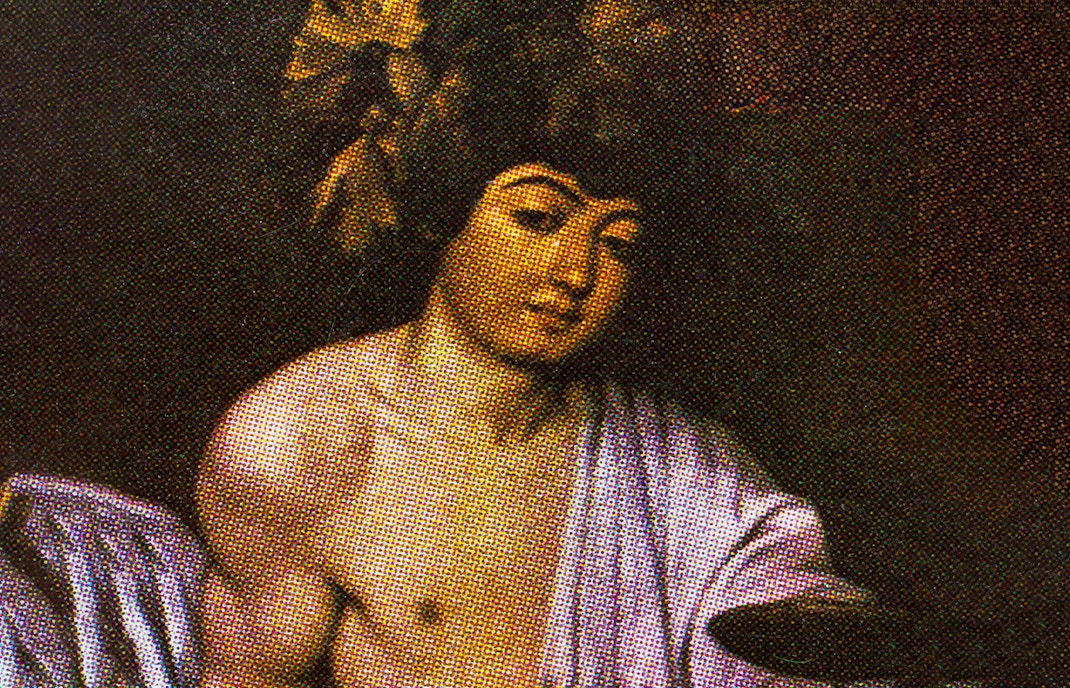
Portraying a youthful, sensual wine god offering a goble wiith lush fruits and human imperfection,this painting blends temptation, realism, and subtle decay: beauty shadowed by mortality.
The Sacrifice of Isaac
Location: Room 90, first floor
This painting captures raw drama through Abraham’s raised hand, Isaac’s terror vivid, and the angel’s urgent grip halting the act of Isaac’s sacrifice. Stark realism and tension make the biblical moment unforgettable.
Frequently asked questions about Caravaggio's Medusa at the Uffizi Gallery
No, entry is included with a standard Uffizi Gallery ticket.
You’ll find it in the Caravaggio rooms, part of the museum’s late Renaissance and Baroque collection on the first floor.
Yes, many Uffizi guided tours cover highlights like Caravaggio’s Medusa, Botticelli’s Birth of Venus, and da Vinci’s Annunciation.
Yes, photography without flash is permitted. Avoid glare by shooting slightly above eye level.
When Caravaggio’s Medusa first appeared, crowds were stunned. The severed head, painted with such terrifying realism, seemed to leap off the shield. Equal parts horrifying and brilliant, it left viewers breathless—shocked, fascinated, and utterly convinced of Caravaggio’s daring genius.
Visit early morning or late afternoon. The Caravaggio rooms are quieter during these times.
Allow at least 10–15 minutes to observe details like the snakes, blood, and convex illusion.

