Hours, location, entrances, and the best time to avoid crowds →
Plan your visit to Accademia Gallery
The Accademia Gallery caps entry at 200 visitors at a time, which is why it feels crowded despite its size. The route is largely linear, and while most come for David, it holds more Michelangelo sculptures than anywhere else, including the Prisoners. Plan well to avoid queues and see beyond the headline piece, this guide covers essential timings, highlights, and practical tips for an efficient visit.
Essential info at a glance
- Hours: Tue–Sun, 9am–7pm (last entry 6pm). Closed Mondays.
- Book ahead. Walk-up lines can hit 60–120 min in peak season. Pre-booked timed entry gets you in within ~15–20 min.
- Arrive 10–15 min early for your slot. One entrance on Via Ricasoli.
- Visit takes ~1–2 hours. Small, linear layout — don't bail after David; the unfinished Prisoners statues and musical instruments collection are worth seeing too.
- Travel light. Big bags/backpacks must be checked at the free cloakroom. Security adds time.
- Photos OK, no flash or selfie sticks.
- No food inside (beyond the entrance area). Grab water before you go in.
- Best times: Opening (9am) or after 4pm to avoid crowds.
- Tickets: Basic entry from €27 | + audio guide from €31 | guided tour from €32 | Uffizi combo from €50.
Everything you need to know for your Accademia visit
🕒 Where & when to go
🗺️ Getting around the gallery
🎟️ Pick the right ticket
♿ Facilities & accessibility
📋 Rules & tips
📍Explore nearby
Where & when to go?
Location
Address: Via Ricasoli 58/60, Florence
- By train: Florence Santa Maria Novella railway station is about a 15-minute walk from the museum.
- By bus: Local buses 6, 11, 13, 14, and 17 stop a few minutes from the gallery.
- By taxi: Taxis are easy to find in central Florence and typically cost €6–€10 for short rides within the historic center.
Entrance
The museum has one main entrance on Via Ricasoli, but several access lanes depending on your ticket type:
- 🔴 Red lane: Reserved timed-entry, skip-the-line, and guided tours (usually fastest).
- 🔵 Blue lane: On-site ticket purchases (longest waits in peak season).
- 🟢 Green lane: Guided groups and hosted entries.
- ♿ Accessible lane: Step-free access for visitors with mobility needs.
Timings
Tuesday–Sunday: 8:15am–6:50pm
Closed: Mondays
Last entry: 6:20pm
Best time to visit: Early morning (opening time) is the quietest window, before tour groups arrive. Crowds build late morning through early afternoon, especially around the gallery’s most famous work, David.
Late afternoon visits (after ~4pm) are often calmer and easier to navigate.
Navigating the Accademia Gallery
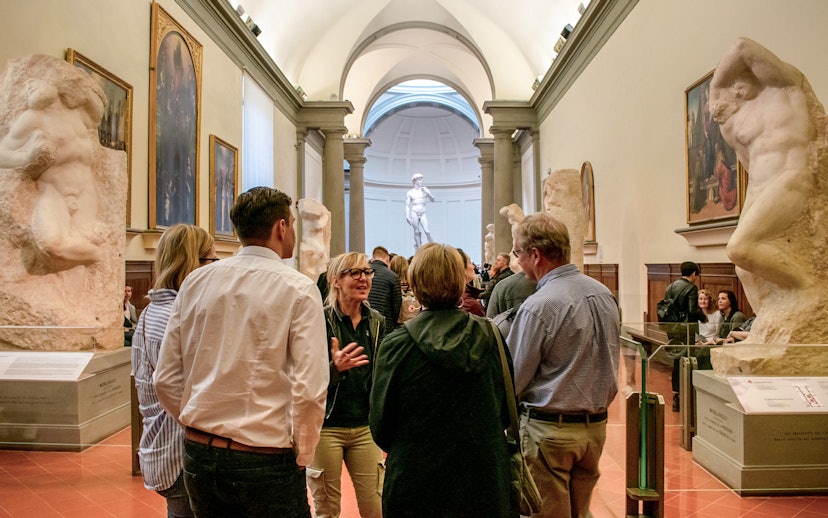
The Accademia Gallery is compact and organized around a central sequence of halls leading to its centerpiece, David. Unlike large museums with multiple wings, the layout follows a mostly linear route through sculpture halls before branching into painting galleries and smaller collections, making it easy to navigate in about 60–90 minutes.
Museum layout
- Main levels: The gallery is spread across two main floors, ground floor an first floor.
- Ground floor: Main galleries including the Hall of the Colossus, Hall of the Prisoners, the Tribune (home to David), the Gipsoteca Bartolini, and the Museum of Musical Instruments.
- First floor: Accessible via stairs or a lift; Quieter galleries with Florentine Gothic and late Gothic paintings from the 14th–15th centuries.
Visitor flow
Start on the ground floor at the Hall of the Colossus, then move to the Hall of the Prisoners to see Michelangelo’s unfinished Slaves before reaching the Tribune, home to David.
Continue to the Gipsoteca Bartolini (plaster casts), then head upstairs for the quieter Gothic painting galleries. Return downstairs to the Museum of Musical Instruments, before exiting via the bookshop on Via Ricasoli.
Maps & tools
- Museum map: Screenshot or download a map before arrival to locate key rooms like the Tribune and Gothic galleries. See below
- On-site signage: Directional boards guide visitors sequentially through the galleries, so following the main corridor will naturally lead you to the highlights.
- Audio Guide: Available as an add-on to your entry ticket in multiple languages for rich context without needing a map.
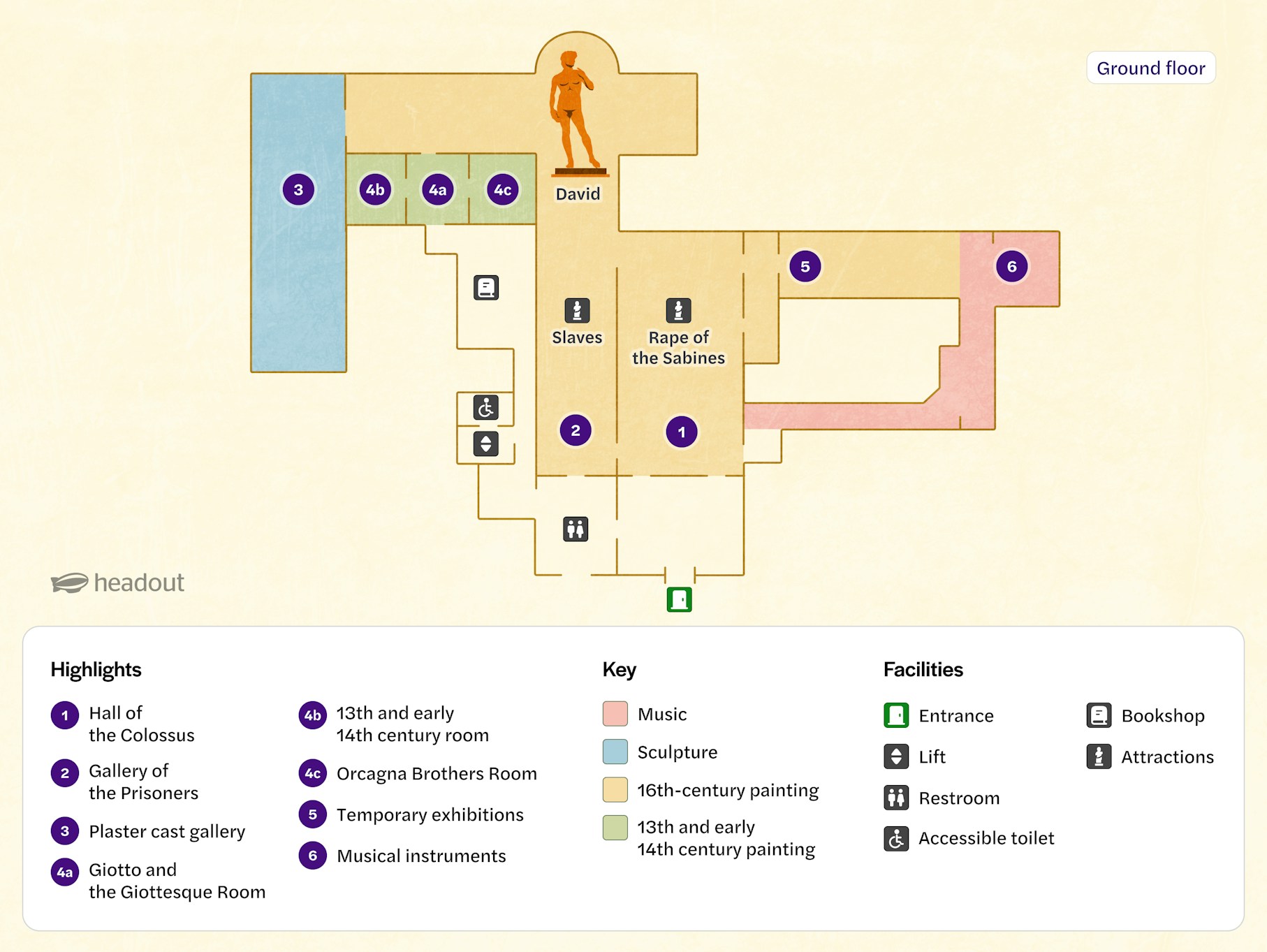
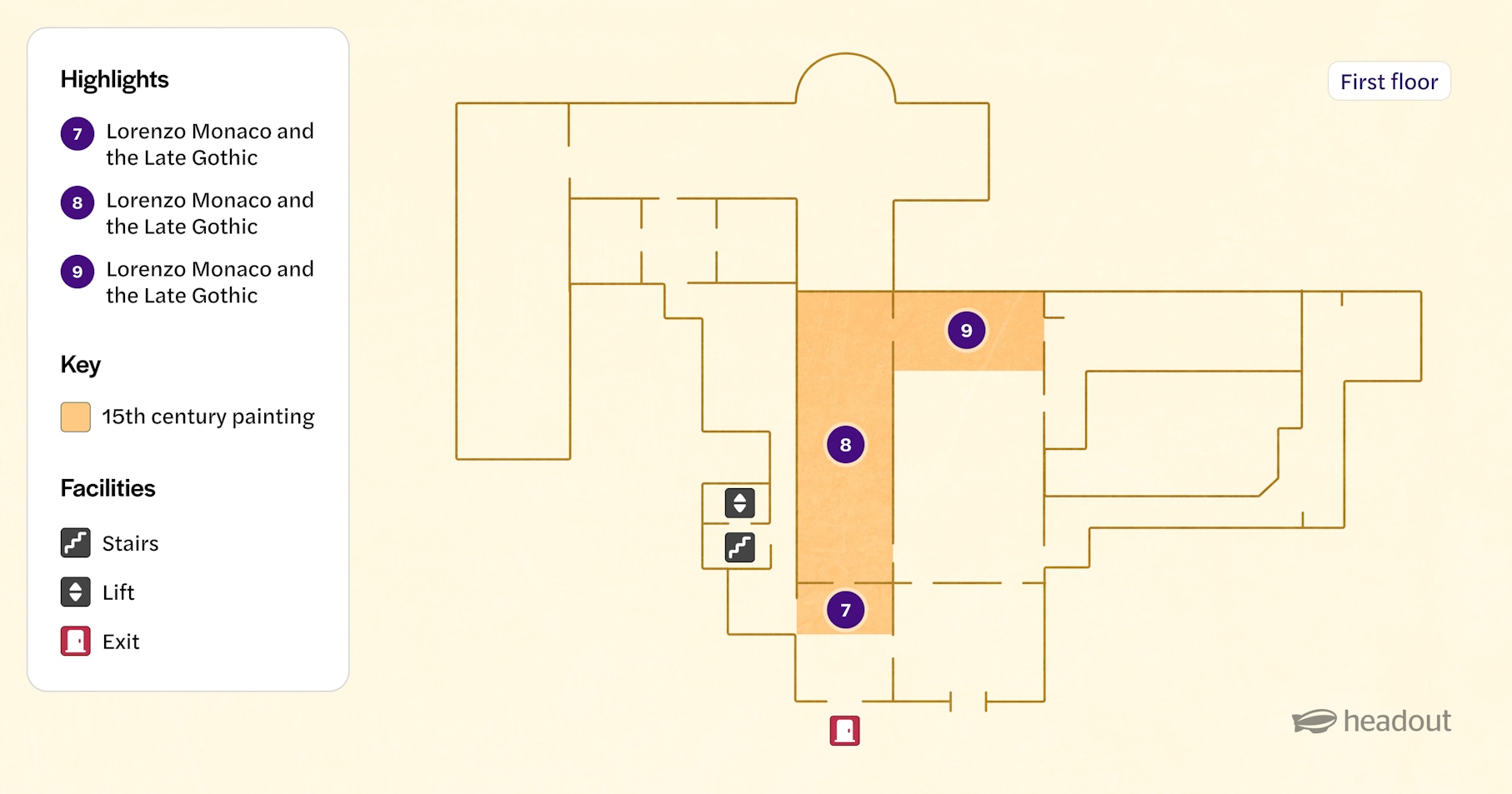
Accademia Gallery highlights: What not to miss

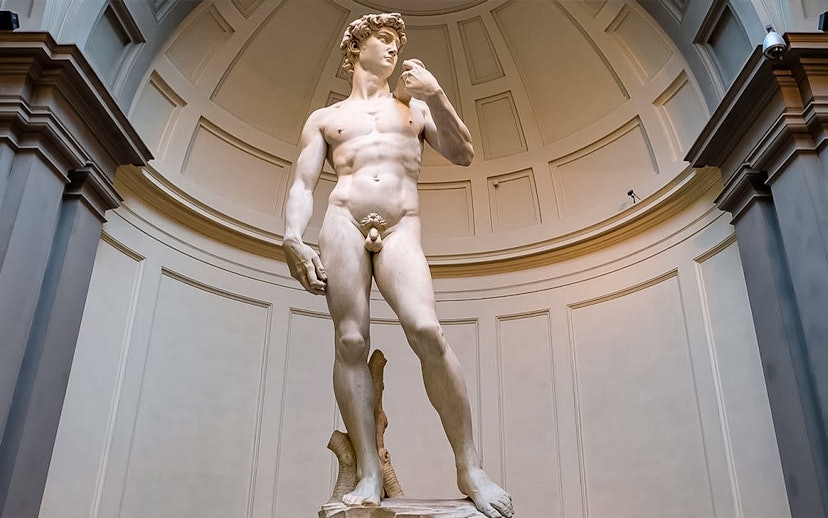
Michelangelo’s David
Artist: Michelangelo Buonarroti, 1501–1504
This 17-foot marble masterpiece depicts the biblical hero poised before battle, famed for its anatomical precision and symbol of Florentine strength; moved indoors in 1873 for protection.
Location: Tribune (ground floor central hall), straight ahead after Prisoners corridor.

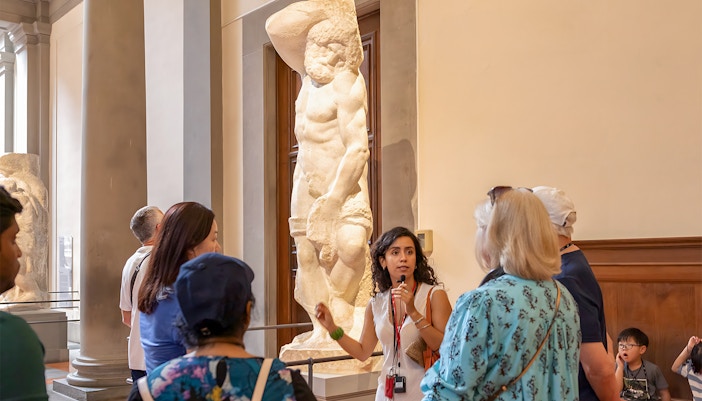
Prisoners (Slaves)
Artist: Michelangelo Buonarroti, c. 1520–1534
Four unfinished marble figures struggling to emerge from stone, originally for Pope Julius II’s tomb, revealing Michelangelo’s “non-finito” technique.
Location: Hall of the Prisoners (ground floor), en route from entrance to David.

Palestrina Pietà
Artist: Michelangelo Buonarroti (attrib.), c. 1547–1555
Incomplete sculpture of Mary cradling Christ, blending sorrow and divinity; debated authorship but showcases emotional depth.
Location: Tribune, beside David.

Rape of the Sabines (Colossus)
Artist: Giambologna, c. 1582
Full-scale plaster model of a dynamic Mannerist sculpture, viewable from all angles to study its spiraling composition.
Location: Hall of the Colossus (ground floor entrance hall)

Madonna of the Sea
Artist: Sandro Botticelli, c. 1468
Early Renaissance painting with graceful figures, Virgin and Child amid angels, highlighting Botticelli’s emerging style.
Location: First floor, early Renaissance painting gallery.

Stradivari Instruments
Artist/Craft: Antonio Stradivari, c. 1690
Medici collection including rare viola and cello quartets, pinnacle of luthier craftsmanship blending art and music.
Location: Museum of Musical Instruments (ground floor, near Colossus).

Vallombrosa Altarpiece
Artist: Perugino, 1500
Glittering Assumption of the Virgin with masterful perspective and serene landscape.
Location: Hall of the Colossus walls (ground floor).

Gipsoteca Bartolini
Artists: Lorenzo Bartolini et al., 19th century
Plaster casts including Reclining Venus, offering insight into 19th-century sculptural process.
Location: Ground floor, left after David Tribune.
Which Accademia Gallery ticket is best for you
| Ticket type | What’s included | Best for | Price range |
|---|---|---|---|
Entry ticket | Timed entry to Accademia Gallery | Quick entry to see David | Entry (from €27) |
Ticket + audio guide | Timed entry + multilingual audio guide | Self-paced visit with artwork context | Audio guide (from €31) |
Guided tour | Skip-the-line entry + expert guide + headsets | Structured visit with expert insights | Guided tour (from €32) |
Combo: Uffizi + Accademia | Entry to Uffizi Gallery + Accademia + audio guides for both sites | See Florence’s top museums in one visit | Combo with Uffizi (from €50) |
Facilities & accessibility

- 🎒 Cloakroom – Free mandatory storage for large bags, umbrellas, and backpacks at the entrance.
- 🚻 Restrooms – Located on the lower ground floor, accessible via stairs or elevator.
- 🛍️ Museum shop – Found near the exit; stocks art books, David-themed souvenirs, and prints.
- 💧 Water fountains – Limited availability; it is best to carry a small plastic water bottle.
- 🪑 Rest areas – Benches are located along the walls of the Tribune near Michelangelo’s David.
- 📶 Wi-Fi – Free high-speed internet access is available throughout the main gallery halls.

- ♿ Physical Disabilities: Wheelchair-accessible main entrance at Via Ricasoli with ramps; elevators link ground/first floors. Free loaner wheelchairs (ID required) at info desk. Wide doors aid mobility; accessible toilets near cloakroom. Staff assist with navigation.
- 👁 Visual Impairments: The gallery provides two permanent tactile maps—one in the Hall of the Colossus and one on the First Floor—to help orient visually impaired guests. These maps feature raised layouts and Braille descriptions of the museum's most significant masterpieces and room locations.
- 🧠 Cognitive & Sensory Needs: To avoid sensory overload, book the first entry (8:15am) or the final slots of the day. The Museum of Musical Instruments is generally the quietest wing, offering a calm environment away from the high-traffic area surrounding the David.

- If you're visiting with young children, 45 minutes is plenty to cover the main attractions of the gallery (including stopping at David)
- Reading up on the gallery's highlights can give children context on the exhibits they're seeing.
- Keep them engaged by asking them to sketch David at different angles.
- Get a snack after: From creamy gelatos to piping hot pizzas, kids are sure to enjoy a meal after an exciting visit.
Rules and restrictions
What you need to know
- Entry requires a timed ticket; all visitors pass through security screening at the main entrance on Via Ricasoli.
- Large bags, backpacks over 40×35×15 cm, tripods, and umbrellas must be stored in the free cloakroom.
- Re-entry is not permitted once you exit the museum.
Not allowed
- No eating, drinking, or carrying food beyond the entrance cafeteria area.
- Smoking and vaping are prohibited inside the gallery and courtyard.
- Pets are not allowed, except certified service animals with documentation.
- Running, touching artworks, or leaning on protective barriers is strictly prohibited.
Good to know
- Photography is allowed for personal use, but flash and selfie sticks are not permitted; video recording is allowed in public halls only.
- There is no strict dress code—comfortable attire is recommended, and bare shoulders or shorts are permitted in sculpture halls.
Practical tips
- Book a timed entry ticket and arrive 10–15 minutes before your slot. Walk-up ticket lines can take 60–120 minutes in peak season, but reserved entry usually gets you through security in about 15–20 minutes.
- The museum is small enough to see in about an hour, so move steadily rather than rushing. Many visitors leave after David, but continuing to the plaster casts and Gothic painting galleries adds important context to the Renaissance works.
- Take advantage of the benches around the Tribune after seeing David. Sitting for a few minutes lets you appreciate the sculpture’s scale and details without the pressure of moving crowds.
- Travel light and dress comfortably. Security checks are mandatory and can add 10–25 minutes, especially with large backpacks. Narrow doorways in some galleries also make big bags awkward to manage.
- Bring water before entering. Food isn’t allowed inside the museum, but cafés and gelato shops around nearby squares are good stops after your visit.
Must-visit landmarks near the Accademia Gallery

Florence Cathedral
Distance: ~500 m from the Accademia Gallery
Travel time: 5–7 min walk
Why visit: Florence’s most famous cathedral complex with Brunelleschi’s Dome at its center. Easy to pair with your visit since it’s just a short walk away, many visitors cover both in one morning.

Uffizi Gallery
Distance: ~1 km from the Accademia Gallery
Travel time: 12–15 min walk
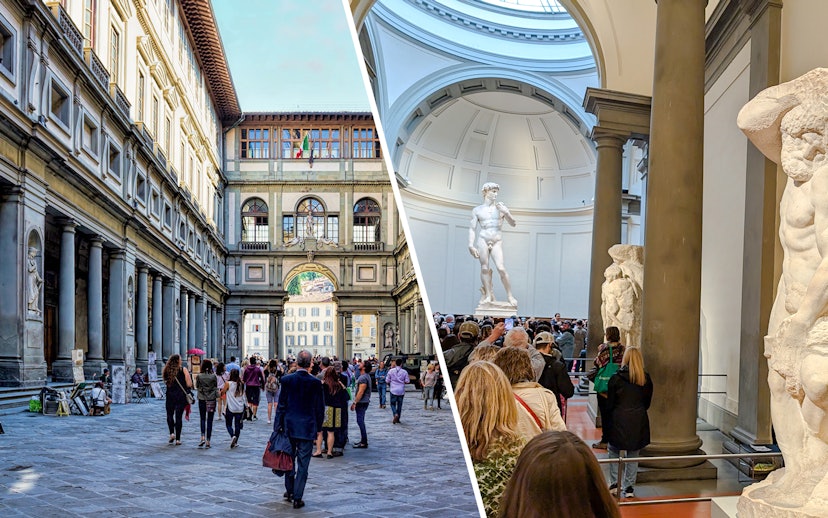
Why visit: One of the world’s top Renaissance museums, featuring works by Sandro Botticelli and Leonardo da Vinci. A natural follow-up to the Accademia, often visited later the same day with timed entry.

Palazzo Vecchio
Distance: ~1 km from the Accademia Gallery
Travel time: 12 min walk
Why visit: Florence’s historic town hall with grand interiors and a climbable tower. Located on Piazza della Signoria, making it an easy add-on stop without extra planning.
Eat, shop & stay near Accademia gallery

Caffè Accademia (Entrance Area): Quick self-service counter with coffee, pastries, panini (€4-8); ideal 10-minute refresh before sculpture halls.
No full on-site restaurant.
For sit-down meals, try these within 5-min walk:
- Ala Grande Caffè (Via S. Gallo 29R, 3-min walk): Breakfast sandwiches, crepes, espresso in cozy brick space. Google Maps
- Ristorante Accademia (Piazza San Marco 7r, 4-min walk): Tuscan pasta, bistecca (€15-25); reliable local spot post-visit. Google Maps
- Trattoria Mario (Via Rosina 2r, 5-min walk): Communal tables, daily-changing Tuscan classics (€12-20); cash-only lunch rush. Google Maps
Tip: Grab gelato at Dondoli (2-min walk) for €3 treat—beats cafeteria lines.
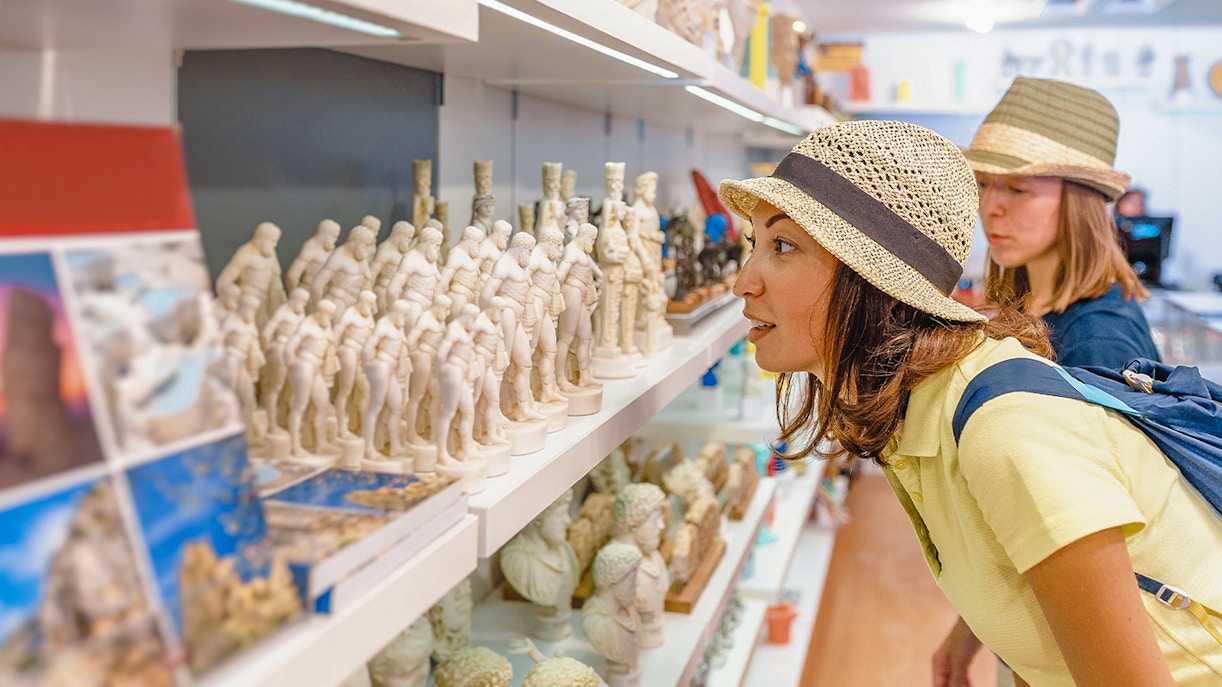
- Main Gift Shop (Near Exit): Books on Michelangelo, David replicas, postcards, magnets; open till closing. Signature items include plaster casts, art prints, and jewelry.
- Instrument Kiosk (Ground Floor): Stradivari-themed souvenirs, music scores, small replicas near Musical Instruments Museum.
- Temporary Exhibit Stand: Exhibition catalogs, posters during shows like Spinello Aretino triptych. Focus on scholarly publications and limited-edition prints.

The Accademia area around San Marco sits in Florence's university district—central, walkable to Duomo (10 mins), safe yet lively with students and tourists. It's moderately priced vs. pricier riverfront, packed with affordable eateries but can feel busy; great base for 1-3 night art-focused stays with easy bus/foot access.
- Luxury: Hotel Regency (8-min walk) – Elegant rooms, garden terrace. Google Maps
- Mid-range: Hotel Machiavelli Palace (5-min walk) – Spacious, rooftop views. Google Maps
- Budget: Plus Florence Hostel (6-min walk) – Modern dorms, shared kitchen. Google Maps
- Airbnb Alternative: Cozy apartments in San Marco (3-7 min walk) – Kitchen-equipped for families.
Tip: University vibe suits solo/couples; families prefer quieter Santa Croce (15-min walk) for space.
Frequently asked questions about visiting Accademia Gallery
Most visitors spend 1–2 hours seeing the highlights, including David and the Hall of the Prisoners. A quick highlights visit can take about 60 minutes, while art lovers may stay longer.
Yes, especially from spring to fall. The museum uses timed-entry tickets, and popular slots often sell out days ahead. Booking in advance avoids long ticket lines outside the museum.
Usually yes. Walk-up ticket lines can reach 60–120 minutes in peak season, while reserved-entry tickets typically pass through security in about 15–20 minutes.
Arrive 10–15 minutes before your scheduled time. This allows time for security screening and finding the correct entry lane on Via Ricasoli.
Small bags are allowed, but large backpacks and bulky items must be stored in the free cloakroom near the entrance before entering the galleries.
Yes, personal photography is allowed, including photos of David. However, flash, tripods, and selfie sticks are prohibited.
Yes, Accademia Gallery allows groups to visit. Some guided tours are also available for groups.
Yes, the Accademia Gallery is suitable for families with children.
The Accademia Gallery is accessible for visitors with disabilities, with a ramp and accessible entrance.
Unfortunately, food and drinks are not allowed inside the Accademia Gallery, except for water. The museum does not have any restaurants or cafes on its premises, but there are many cafes and restaurants nearby where visitors can have a meal before or after their visit.