Tickets Florence

Visiting Palazzo Vecchio: your complete guide

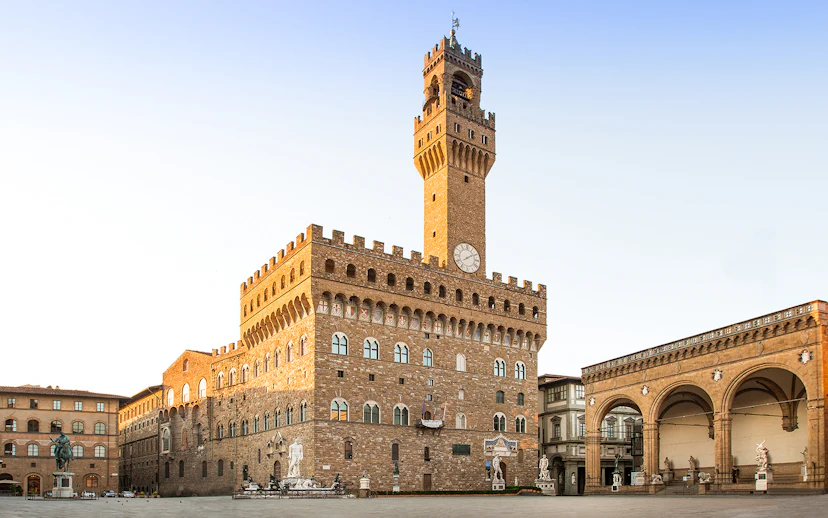
Palazzo Vecchio is Florence’s medieval town hall and Renaissance civic palace, best known for the vast Salone dei Cinquecento and its still-working role as the seat of city government. A visit feels bigger and more layered than many people expect, with monumental rooms, sparse labeling, and occasional civic closures that can reshape your route. The biggest difference between a rushed visit and a rewarding one is whether you plan for the tower, Secret Passages, or just the main museum in advance. This guide covers timing, entrances, tickets, and how to pace it well.

Quick overview: Palazzo Vecchio at a glance

If you only read one section before booking, make it this one.

  • When to visit: Mon, Tue, Wed, Fri, Sat, and Sun 9am–7pm, Thu 9am–2pm. Tue or Wed right at 9am is noticeably calmer than 11am–1:30pm in May–Sep, because Palazzo Vecchio catches the spillover crowd from the Duomo, Uffizi, and cruise-day arrivals.
  • Getting in: From €12.50 for standard entry. Guided tours usually start from about €35, while Secret Passages tours start from about €41. Advance booking matters most for the tower and Secret Passages in summer, while standard museum entry is usually easier to get late.
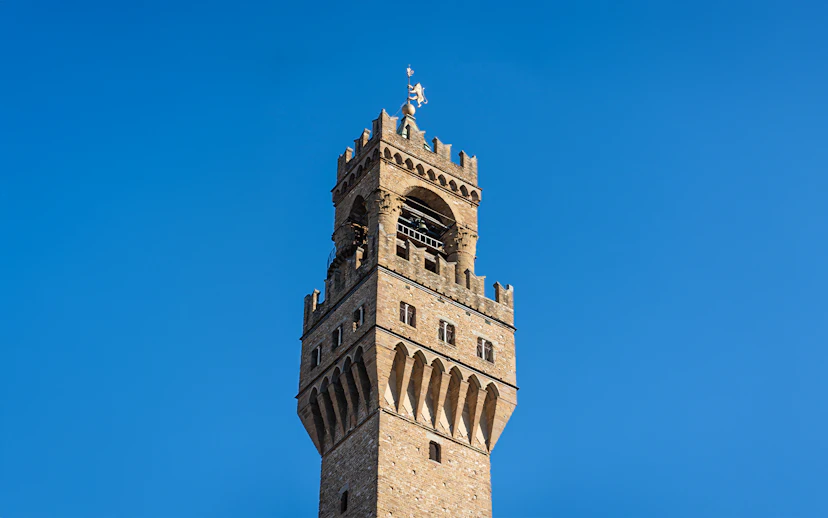
  • How long to allow: 1.5–2 hours for most visitors. It stretches to 2.5–3 hours if you add the Arnolfo Tower, an audioguide, or stop properly in the apartments and map room.
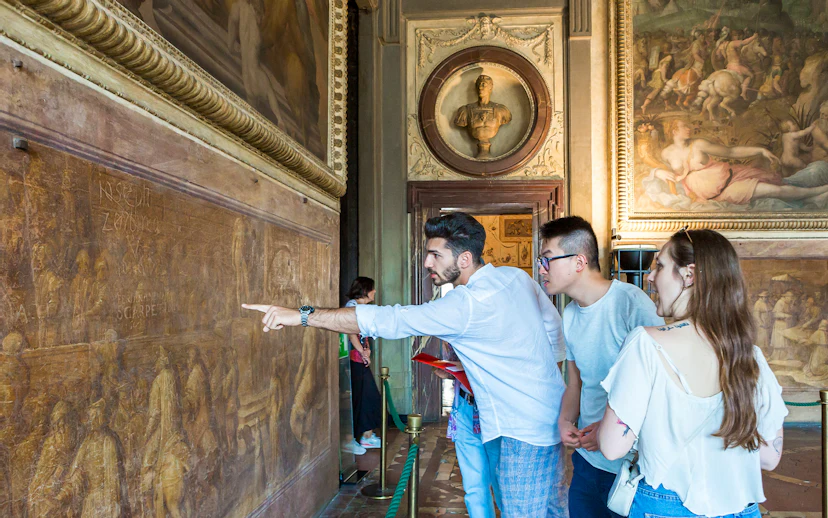
  • What most people miss: The Bronzino Chapel of Eleonora and the Hall of Geographical Maps both reward slowing down, but many visitors rush through them after the Salone.
  • Is a guide worth it? Yes, if this is your first visit or you want the Medici story to make sense; otherwise an audioguide is the cheaper fix for the palace’s thin labeling.

🎟️ Tower and Secret Passages slots for Palazzo Vecchio sell out 2–7 days in advance during summer. Lock in your visit before the time you want is gone. See ticket options

Jump to what you need

Where and when to go

💡 Pro tip

The first Sunday of the month is not a free-for-all bargain day for most travelers — free civic-museum entry applies to Florence metropolitan residents, so non-residents still pay full price and face the longest lines of the month.

How much time do you need?

Visit typeRouteDurationWalking distanceWhat you get

Highlights only

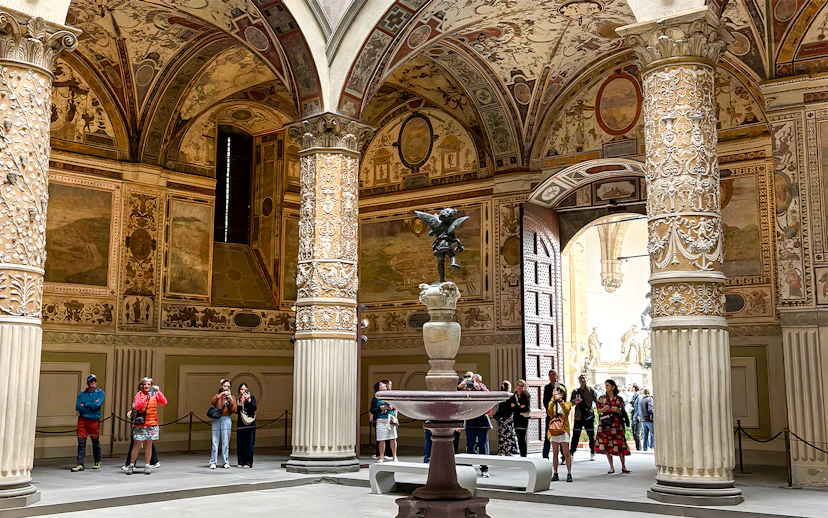
Courtyard → Salone dei Cinquecento → Hall of Maps → Sala dei Gigli → exit

1–1.5 hours

~0.8km

You see the palace’s biggest rooms and best-known works, but you’ll move quickly and skip the tower, the chapel details, and all behind-the-scenes spaces.

Balanced visit

Courtyard → Salone dei Cinquecento → Apartments of Eleonora → Bronzino Chapel → Hall of Maps → Sala dei Gigli → tower if booked → exit

2–2.5 hours

~1.4km

This adds the quieter rooms that most visitors rush past, and the tower if you’ve booked it, making it the best all-around route without committing to a specialist tour.

Full exploration

Courtyard → Secret Passages tour → Studiolo of Francesco I → Tesoretto → trusses above the Salone → main museum route → Arnolfo Tower → exit

3+ hours

~2km

This is the most complete visit and the one that changes opinions on Palazzo Vecchio, but it requires more stamina, more stairs, and either a premium guided tour or multiple add-ons.

Which Palazzo Vecchio ticket is best for you

Ticket typeWhat's includedBest forPrice range

Museo di Palazzo Vecchio entry ticket

Timed entry + Salone dei Cinquecento + monumental rooms

A shorter Florence itinerary where you want the palace’s core rooms without committing extra time to the tower or guided access areas

From €30

Palazzo Vecchio Museum + Arnolfo Tower ticket

Timed museum entry + Arnolfo Tower + Camminamento di Ronda

A visit where the indoor route alone will feel incomplete unless you also get a skyline view that includes the Duomo

From €27

Palazzo Vecchio skip-the-line guided tour

Priority entry + licensed guide + public palace route

A first visit where sparse labels would otherwise leave you looking at extraordinary rooms without enough context

From €37

Palazzo Vecchio Secret Passages guided tour

Priority entry + small-group guide + museum entry + Studiolo of Francesco I + Tesoretto + trusses above the Salone

A return visit, or any Medici-focused visit, where you want access to the rooms that standard entry does not cover

From €37

Palazzo Vecchio + Accademia combo

Timed entry to Palazzo Vecchio + timed entry to Accademia + hosted or skip-the-line access depending on option

A 1-day Florence plan where you need 2 major sights booked together and don’t want to risk Accademia selling out separately

From €55

How do you get around Palazzo Vecchio?

Where are the masterpieces inside Palazzo Vecchio?

Salone dei Cinquecento interior
Chapel of Eleonora frescoes
Hall of Geographical Maps
Donatello Judith and Holofernes
Michelangelo Genius of Victory
Studiolo of Francesco I
1/6

Salone dei Cinquecento

Room / era: 16th-century grand council hall redesigned by Giorgio Vasari

The Salone dei Cinquecento is the room that justifies the visit on its own: 54m long, 23m wide, and built to overwhelm. Most people notice the scale first and the politics second, but the ceiling’s 39 painted panels are really a giant Medici power statement. The detail many visitors rush past is Cosimo I’s turtle-with-sail emblem, which turns up as a quiet signature of ducal propaganda.

Where to find it: Straight ahead after the main ticket scan at the top of the staircase.

Chapel of Eleonora

Artist: Agnolo Bronzino

This private chapel is one of the palace’s finest painted spaces, but it’s small enough that plenty of visitors pass through too fast. Bronzino’s frescoes reward close looking, especially in the side walls where color and storytelling matter more than scale. The easy-to-miss detail is that it sits inside Eleonora of Toledo’s apartments, so crowd flow often pulls people onward before they stop.

Where to find it: Inside the Apartments of Eleonora, off the main museum route beyond the Salone.

Hall of Geographical Maps

Creator / era: Egnazio Danti and Stefano Bonsignori, 16th century

The Hall of Geographical Maps feels surprisingly modern in ambition: it turns Medici Florence into a room-sized statement about global knowledge and control. Many people glance at the painted cabinets and move on, but the old maps of distant territories are the point, not just the decoration. Look up for the suspended globe, which many visitors miss because they stay focused on the cabinet fronts.

Where to find it: On the upper museum route, after the apartments and before the civic halls near the exit.

Judith and Holofernes

Artist: Donatello

Donatello’s bronze Judith and Holofernes is one of the palace’s most important sculptures, yet it’s easy to miss because it doesn’t get the same build-up as the Salone. It carries a powerful civic message about tyranny and virtue, which matters in a building that was always political. The detail visitors rush past is the inscription and the sculpture’s original role as a public symbol, not just a museum object.

Where to find it: Sala dei Gigli, on the upper-floor civic route.

Genius of Victory

Artist: Michelangelo

This unfinished Michelangelo sculpture stands out for its tension rather than polish, and it feels especially strong in the vastness of the Salone. Most visitors photograph it quickly and keep moving, but the older defeated figure at the base is what gives the work its emotional charge. It is also the only Michelangelo sculpture inside Palazzo Vecchio, which makes it worth more than a passing glance.

Where to find it: Against the east side of the Salone dei Cinquecento.

Studiolo of Francesco I

Room / era: Mannerist curiosity cabinet, 1570s

The Studiolo is the strangest and most memorable interior in the building: a tiny, windowless chamber filled with painted cabinet doors tied to objects once stored behind them. It feels completely different from the palace’s ceremonial rooms, which is exactly why it stays with people. What most visitors miss is that every painted panel once concealed a working cabinet, so the room was part collection, part code system.

Where to find it: Off the Salone area, accessible only on the Secret Passages guided tour.

💡 Before you leave, don’t miss these spots.

The Chapel of Eleonora, which is tucked inside the apartments and easy to breeze past after the Salone, and Donatello’s Judith in Sala dei Gigli, which many people miss because the exit flow pulls them onward from the map room.

Facilities and accessibility

  • 🎒 Cloakroom / lockers: A free cloakroom on the ground floor is mandatory for umbrellas, backpacks, and large bags before you enter the museum rooms.
  • 🚻 Restrooms: Restrooms are on the ground floor behind the cloakroom, and you reach them before the main museum route begins.
  • 🍽️ Cafe / food options: The in-house café is currently closed, so you should treat on-site vending machines as a backup rather than a real meal stop.
  • 🛍️ Gift shop / merchandise: The museum bookshop sits on the exit route and is the best place for palace-focused books and Florence art-history souvenirs.
  • 💧 Water fountains / bottle refill stations: Bottled water is available from vending machines, which is more reliable here than expecting a proper café stop.
  • 🪑 Seating / rest areas: The main resting spots are in the courtyard and in selected large rooms, but this is not a museum with frequent benches throughout the route.
  • Mobility: The accessible entrance is on Via dei Gondi, where lifts give access to the Salone and main museum floors, but the tower, Camminamento di Ronda, mezzanine areas, and Secret Passages route are not accessible.
  • Mobility: Two wheelchairs are available free at the cloakroom, and accessible restrooms are on the ground floor near the entry facilities.
  • 👁️ Visual impairments: This is not an easy palace to interpret visually without help, because room labels are sparse and many explanatory panels relate to ceilings or upper walls rather than eye-level works.
  • 🧠 Cognitive and sensory needs: The calmest time is the first hour after opening, while late mornings can feel noisy and visually overwhelming in the Salone and entrance sequence.
  • 👨‍👩‍👧 Families and strollers: Strollers work on the main museum floors via the lift route, but the tower, hidden stairs, and tighter historic passages are not pushchair-friendly end to end.

Palazzo Vecchio works best for children who like stories, symbols, secret rooms, and towers more than long, label-heavy gallery visits.

  • 🕐 Time: 1.5–2 hours is realistic with younger children, and the Salone, map room, and tower usually hold attention better than the full apartment sequence.
  • 🏠 Facilities: The ground-floor cloakroom and restrooms make the start of the visit easy, but there is no proper café inside if children need a long snack break.
  • 💡 Engagement: The Hall of Geographical Maps is the easiest place to turn the visit into a game, because children can spot countries, sea routes, and strange Renaissance geography.
  • 🎒 Logistics: Bring water, keep bags small to speed up the cloakroom stop, and avoid the hottest afternoon slots if you’re considering the tower.
  • 🎭 Programs: Fondazione MUS.E family activities such as ‘Life at Court’ are the strongest kid-focused way to visit and are far more engaging than a standard self-guided route.
  • 📍 After your visit: The open-air sculpture area in Piazza della Signoria is the easiest child-friendly decompression stop because it’s immediate, free, and needs no extra walking.

Rules and restrictions

⚠️ Re-entry is not permitted once you exit Palazzo Vecchio.

Plan restroom stops, meals, and rest breaks before leaving — the nearest cafés are only 2–3 minutes away across Piazza della Signoria, but you won’t be allowed back in on the same ticket.

Practical tips

  • Book 2–7 days ahead if you want the Arnolfo Tower or Secret Passages in summer, because those are the parts of Palazzo Vecchio that genuinely cap out, while standard museum entry is usually easier to find late.
  • Arrive 15–20 minutes early for timed entry, especially from May–Sep, because even pre-booked visitors still pass security and often queue briefly at the cloakroom.
  • Don’t judge the palace by the first 20 minutes alone: the Salone is the showstopper, but the Hall of Maps and Chapel of Eleonora are where a self-guided visit starts to feel more distinctive.
  • Bring the smallest bag you can manage, because umbrellas, backpacks, and large bags must be deposited, and that extra stop can add 5–15 minutes on busy mornings.
  • If you’re choosing between the tower and the Duomo dome, pick Palazzo Vecchio’s tower when you want a strong skyline view that actually includes the Duomo itself.
  • Eat before you go if you want a longer visit, since the internal café is closed and the palace is single-entry only.
  • Skip the first Sunday of the month unless you’re a Florence resident using the local free-entry benefit, because everyone else still pays and the lines are often the month’s worst.
  • On rainy days, build a backup plan before you arrive, because the tower can close without much notice even when the indoor museum remains open.

What else is worth visiting nearby?

Eat, shop and stay near Palazzo Vecchio

  • On-site: The palace café is currently closed, so on-site food is limited to vending-machine drinks and snacks and works only as a fallback.
  • Better options nearby
  • Caffè Rivoire (1-min walk, Piazza della Signoria 5/r): Coffee, pastries, and light meals at historic-center prices, but it is hard to beat for pure convenience after your visit.
  • I Fratellini (3-min walk, Via dei Cimatori 38/r): Tiny wine-and-sandwich counter with strong value and a fast stop that suits a short museum day.
  • All’Antico Vinaio (5-min walk, Via dei Neri 65/r): Large focaccia sandwiches and constant lines, but it works well if you want a substantial post-visit meal without sitting down.
  • 💡 Pro tip: Eat before 12 noon or after 2pm if you want something quick nearby, because the whole Piazza della Signoria–Uffizi pocket gets bottlenecked at lunch.
  • Palazzo Vecchio museum bookshop: Art books, palace-focused souvenirs, and exhibition catalogues right on the exit route, making it the most convenient place to buy something specific to your visit.
  • Ponte Vecchio jewelers: Florentine gold and higher-end gifts a short walk away, and worth considering only if you actually want craftsmanship rather than generic old-town souvenirs.

Staying around Piazza della Signoria is absolutely worth it for a short Florence trip if walkability matters more to you than value. You’ll be within minutes of Palazzo Vecchio, the Uffizi, Ponte Vecchio, and the Duomo, but room rates are usually higher and evenings stay busy with restaurant traffic.

  • Price point: This area skews expensive, especially for hotels with historic-center views, though there are occasional mid-range guesthouses on side streets.
  • Best for: Travelers on a 1–2 night stay who want to walk everywhere and keep logistics almost nonexistent.
  • Consider instead: Santa Maria Novella works better for train arrivals and better-value hotels, while Oltrarno suits longer stays if you want a quieter neighborhood feel and stronger local dining.

Frequently asked questions about visiting Palazzo Vecchio

Most visits take 1.5–2 hours, though you should allow 2.5–3 hours if you add the Arnolfo Tower or a guided add-on. A quick highlights-only visit can be done in about 90 minutes, but that often means rushing the Apartments of Eleonora and the Hall of Geographical Maps.

More reads