Palazzo Vecchio, a historic town hall and Renaissance museum, dominates the square with its fortress-like exterior and Arnolfo Tower. You can enter at Piazza della Signoria, 50122 Firenze FI, Italy. The wheelchair accessible entrance is nearby at Via dei Gondi.
Once inside, you are met with the splendor of frescoes, lavish chambers, and breathtaking views that transport you to the golden age of Florence. Here’s everything you can see across all the levels of Palazzo Vecchio Museum.
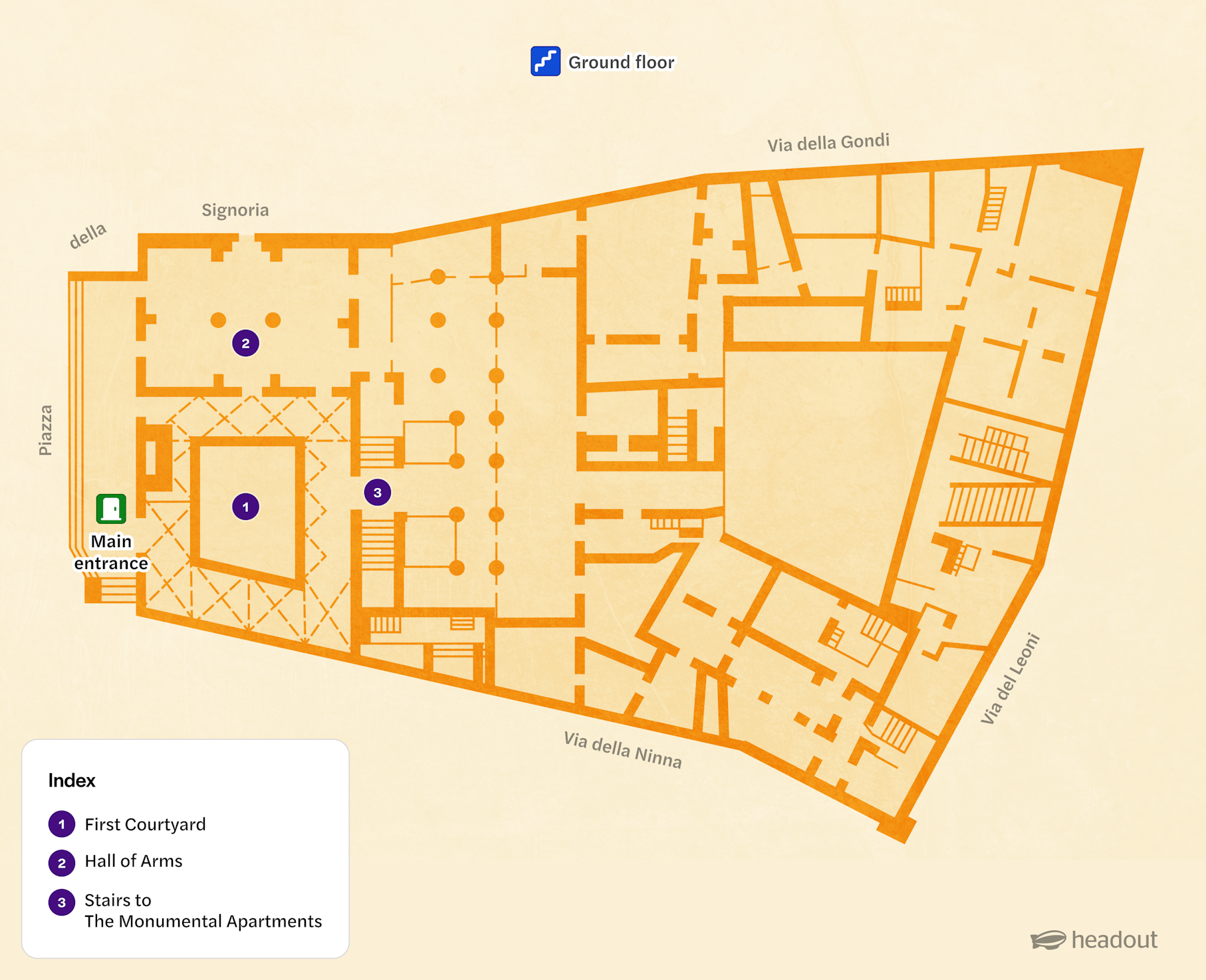
Ground floor
1/7
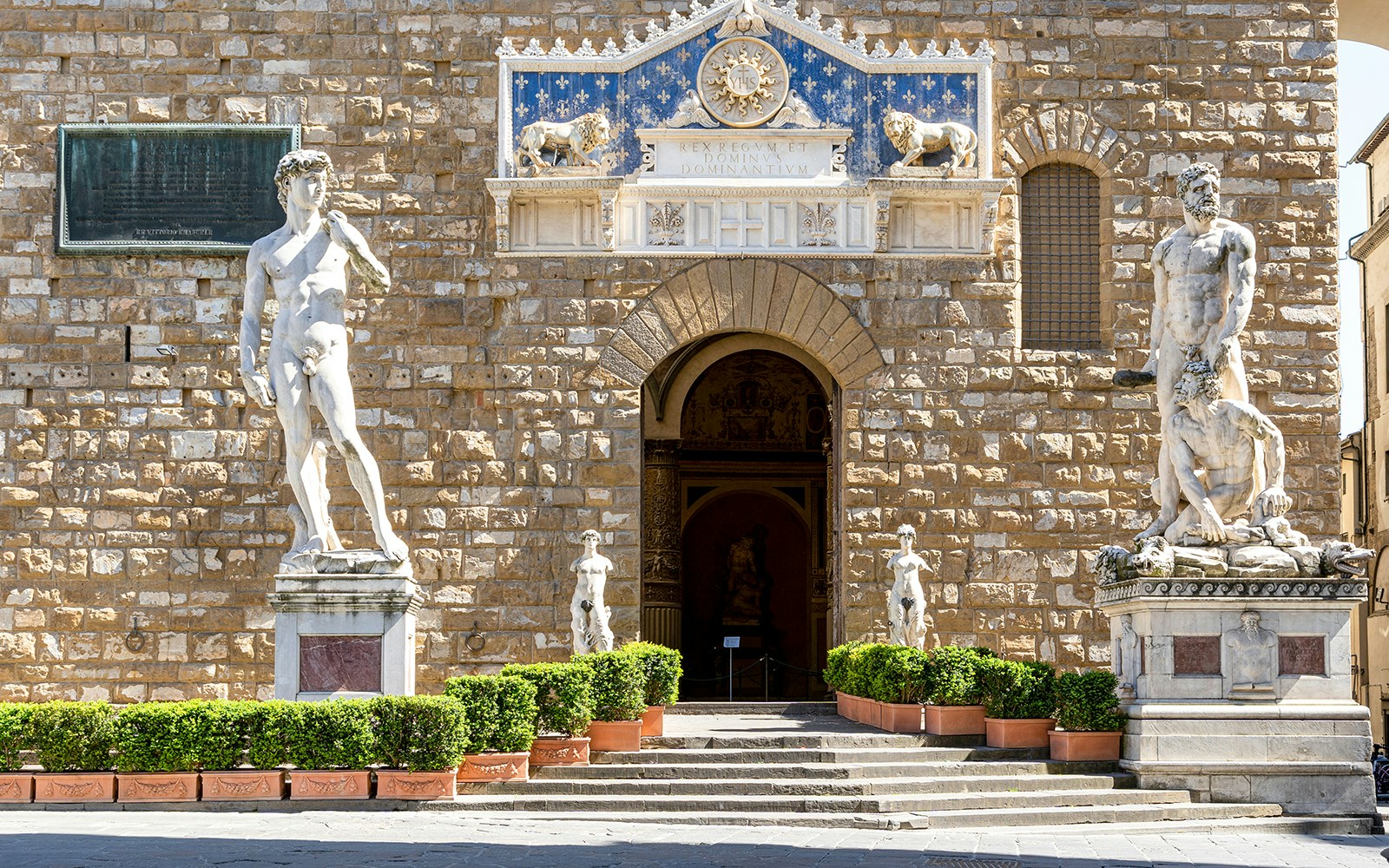
The main entrance of Palazzo Vecchio
is flanked by lifesize statues of David by Michelangelo, and Hercules and Cacus by Bandinelli.
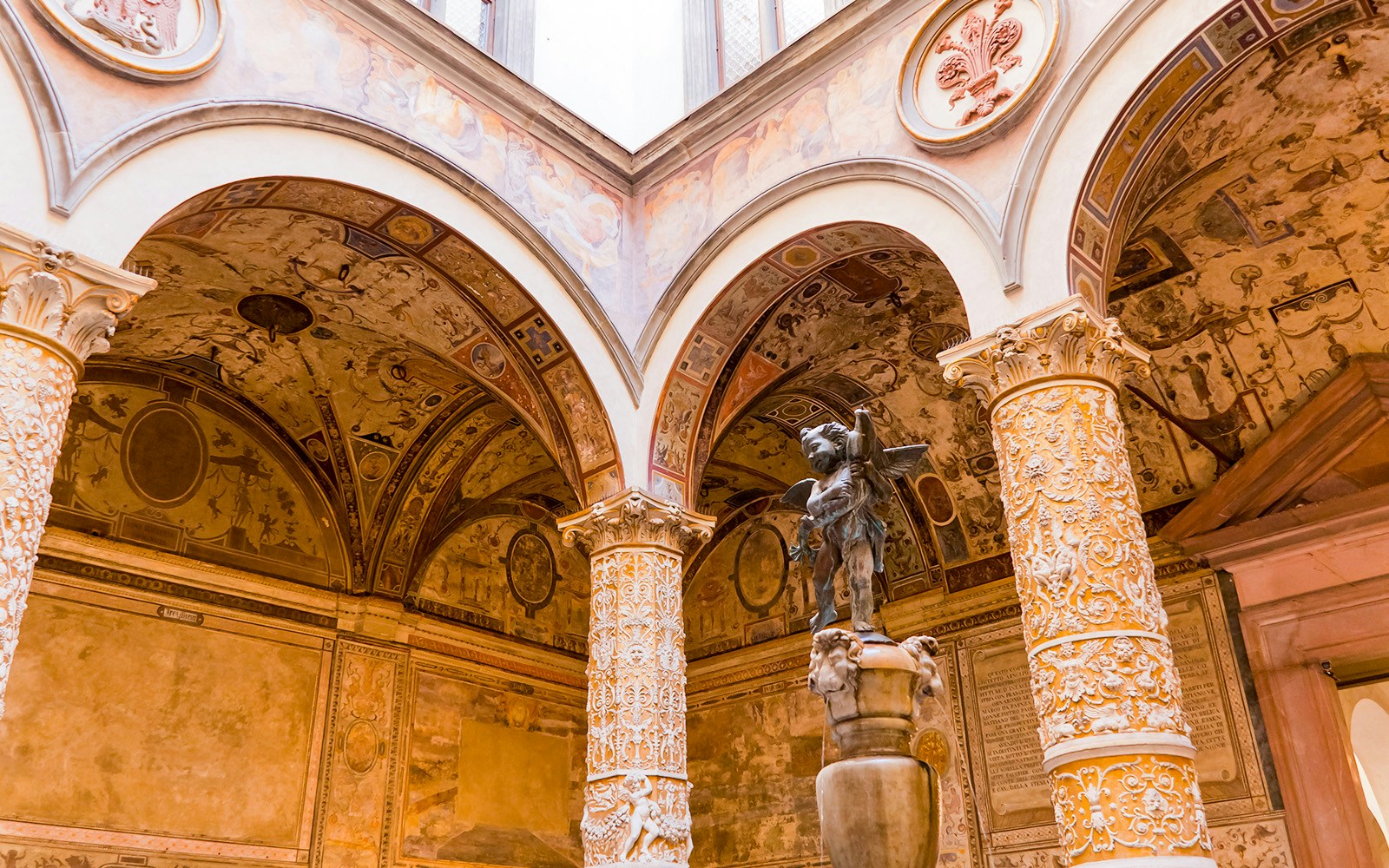
Enter through the First Courtyard
Wander along the stunning loggia, a covered gallery with gilded arches that overlooks this open-air courtyard redesigned by Michelozzo in 1453.
At its center stands a porphyry fountain by Battista del Tadda
crowned by a replica of Verrocchio’s Putto with Dolphin.
White and gilded stucco decorations and frescoes of Habsburg cities
commemorate the marriage of Francesco I de’ Medici and Joanna of Austria.
known as the Courtyard of the Customs, was added in 1494. It originally functioned as the city’s customs office.
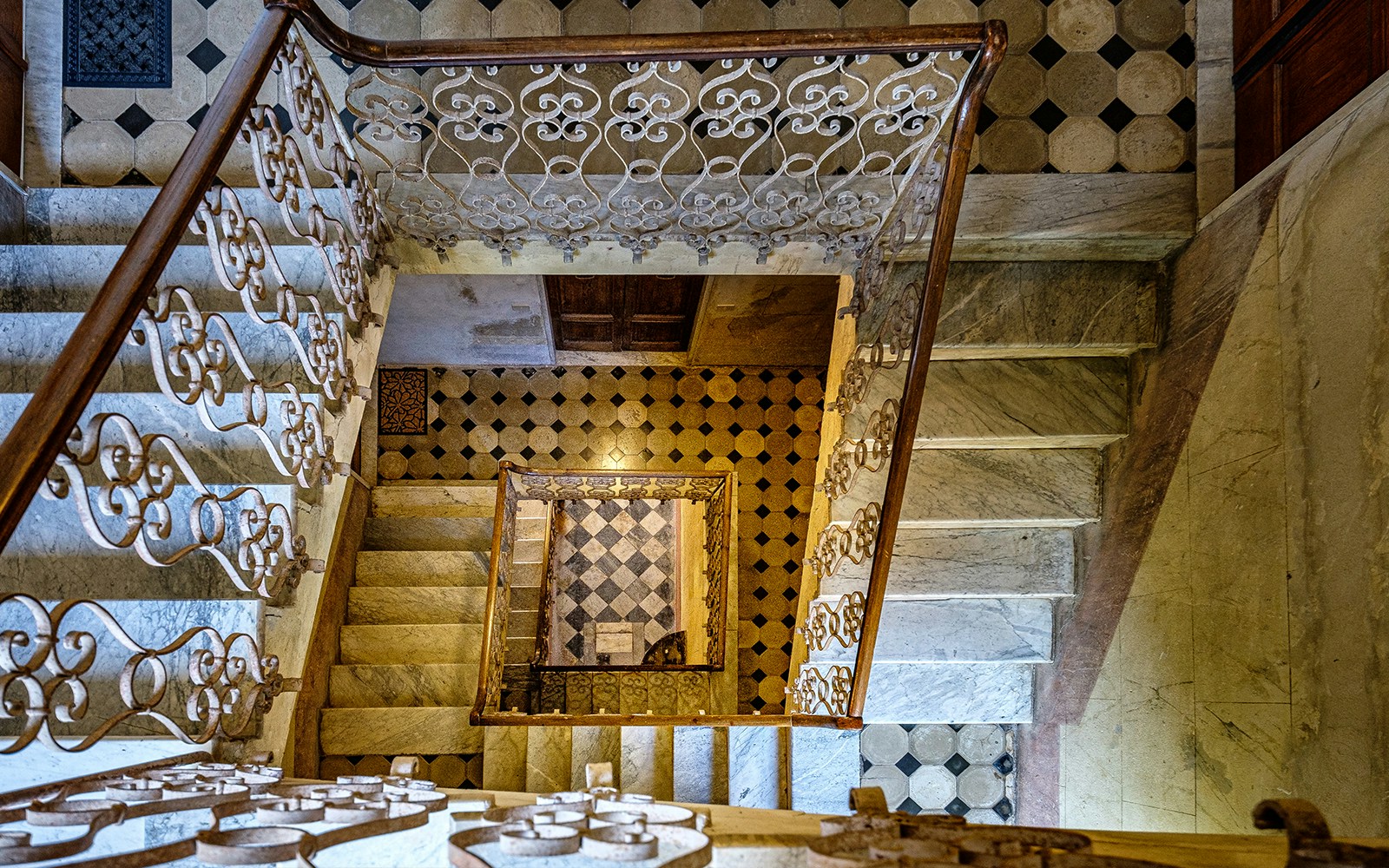
The Monumental Staircase
leads you up to the next levels of Palazzo Vecchio. If you experience mobility issues, take the lift from the Cortile della Dogana instead.
Below the palace lies the ruins of an ancient Roman theater
dating back to the 1st century BC city of Florentia. Palazzo Vecchio's construction in the 14th century occurred directly over some parts of it.
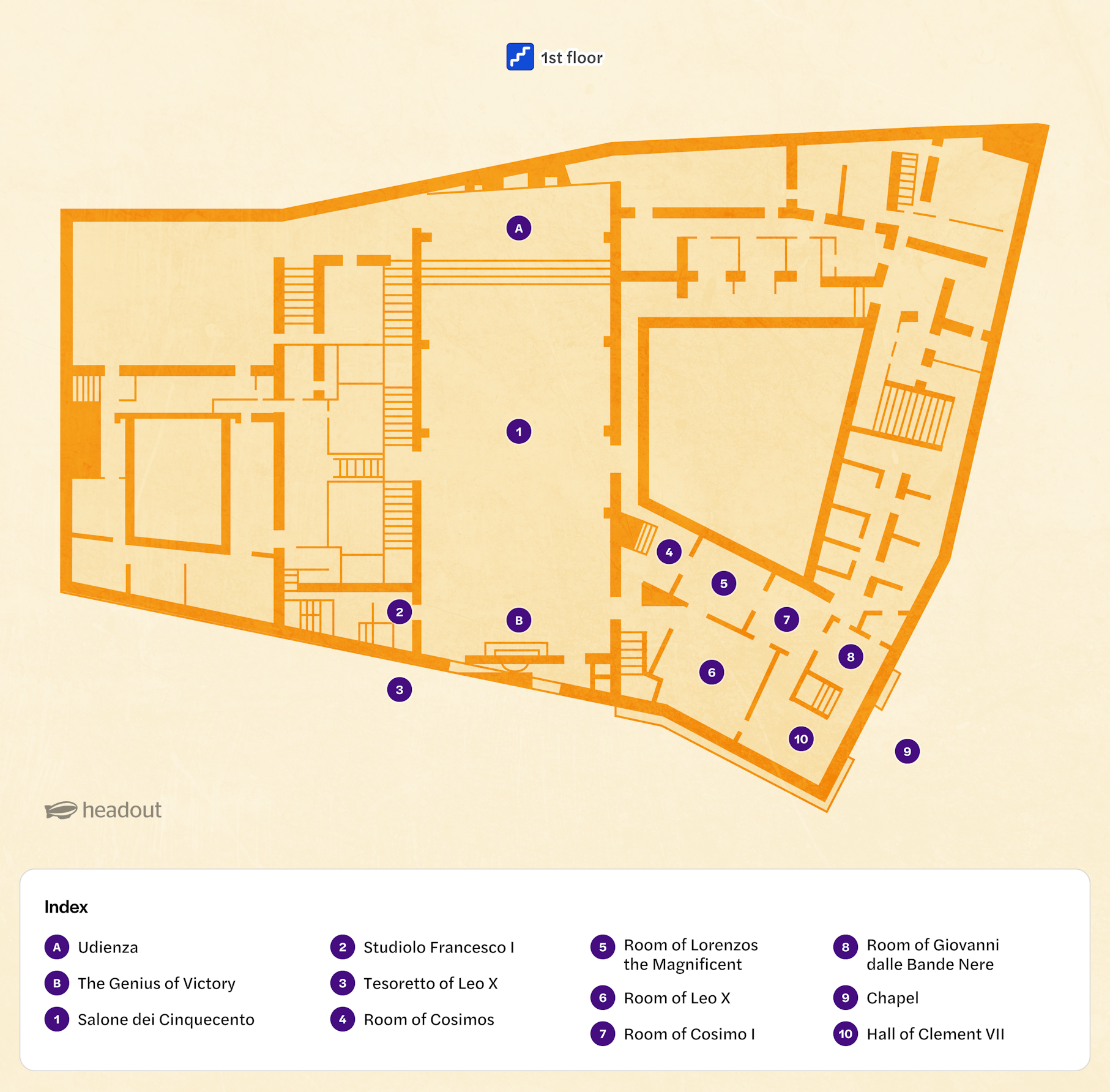
First floor
1/4
Hall of the 500
The highlight of the first floor is the palace’s largest room. At 54m x 23m, the Salone dei Cinquecento was meant to seat a Grand Council. Originally built in 1494 by Simone del Pollaiolo, it was expanded by Giorgio Vasari in the 1560s under Cosimo I de’ Medici. The coffered ceiling features 39 panels depicting Cosimo’s rule.
Massive frescoes stretch across Salone dei Cinquecento's walls
including The Battle of Marciano and The Defeat of the Pisans at the Tower of San Vincenzo, that glorify Medici military victories. Among its sculptures are Michelangelo’s Genius of Victory, originally designed for Pope Julius II’s tomb, and Bandinelli’s bust of Pope Leo X.
Adjacent to the hall is this an intimate, windowless room designed by Vasari (1570–1575). It contains secret cabinets behind painted panels illustrating alchemy, mythology, and the natural world.
The Mezzanine
Lying between the first and second floors, this area houses the Loeser Collection, featuring Renaissance paintings, furniture, and decor donated by art critic Charles Loeser. These rooms retain original 14th and 15th-century ceilings and offer insight into the period's domestic interiors.
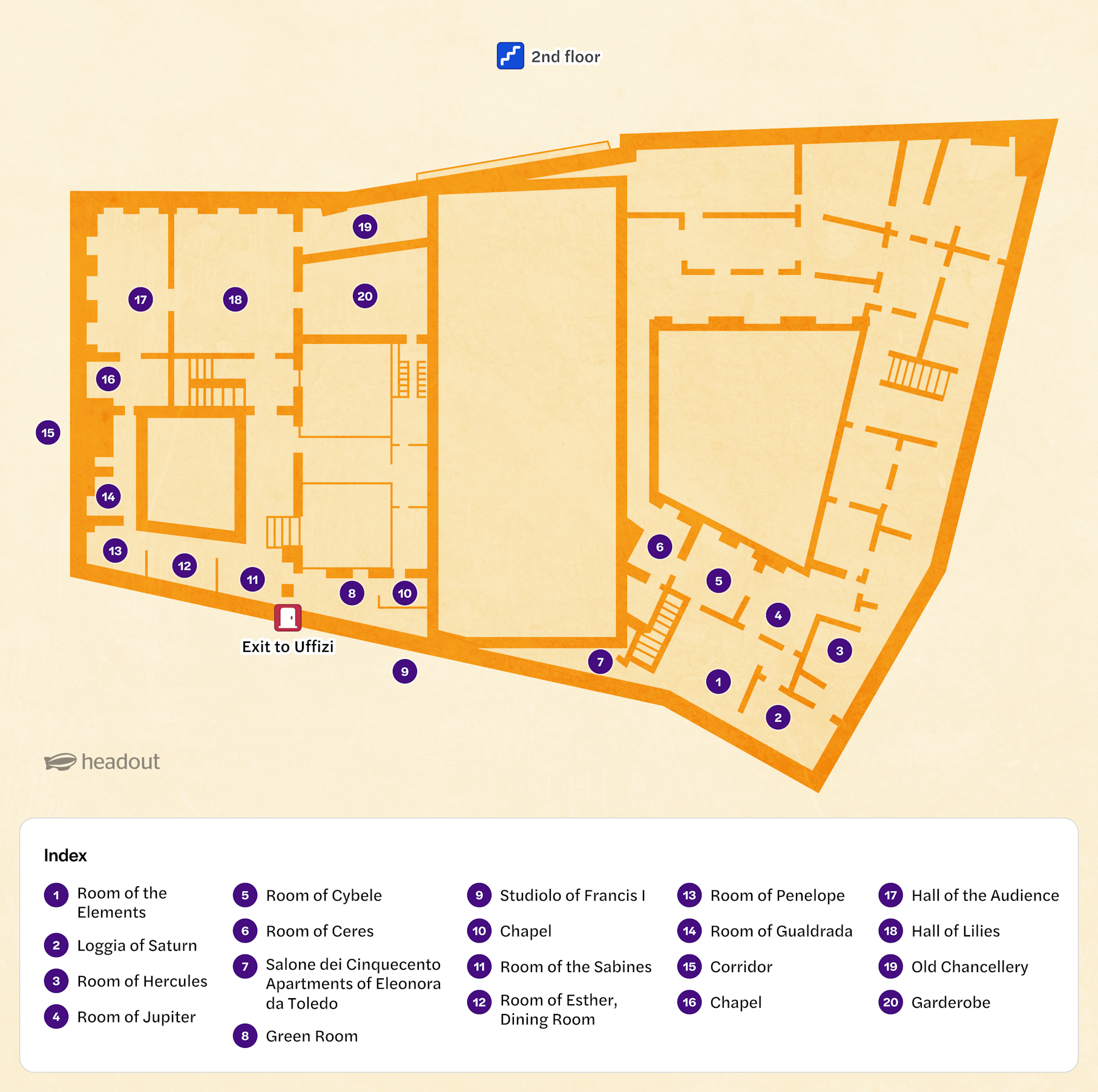
Second floor
1/6
Hall of Lilies (Sala dei Gigli)
Named for its fleur-de-lis decorations, the room features frescoes by Domenico Ghirlandaio, including a depiction of Saint Zenobius. It also houses Donatello's powerful bronze statue Judith and Holofernes.
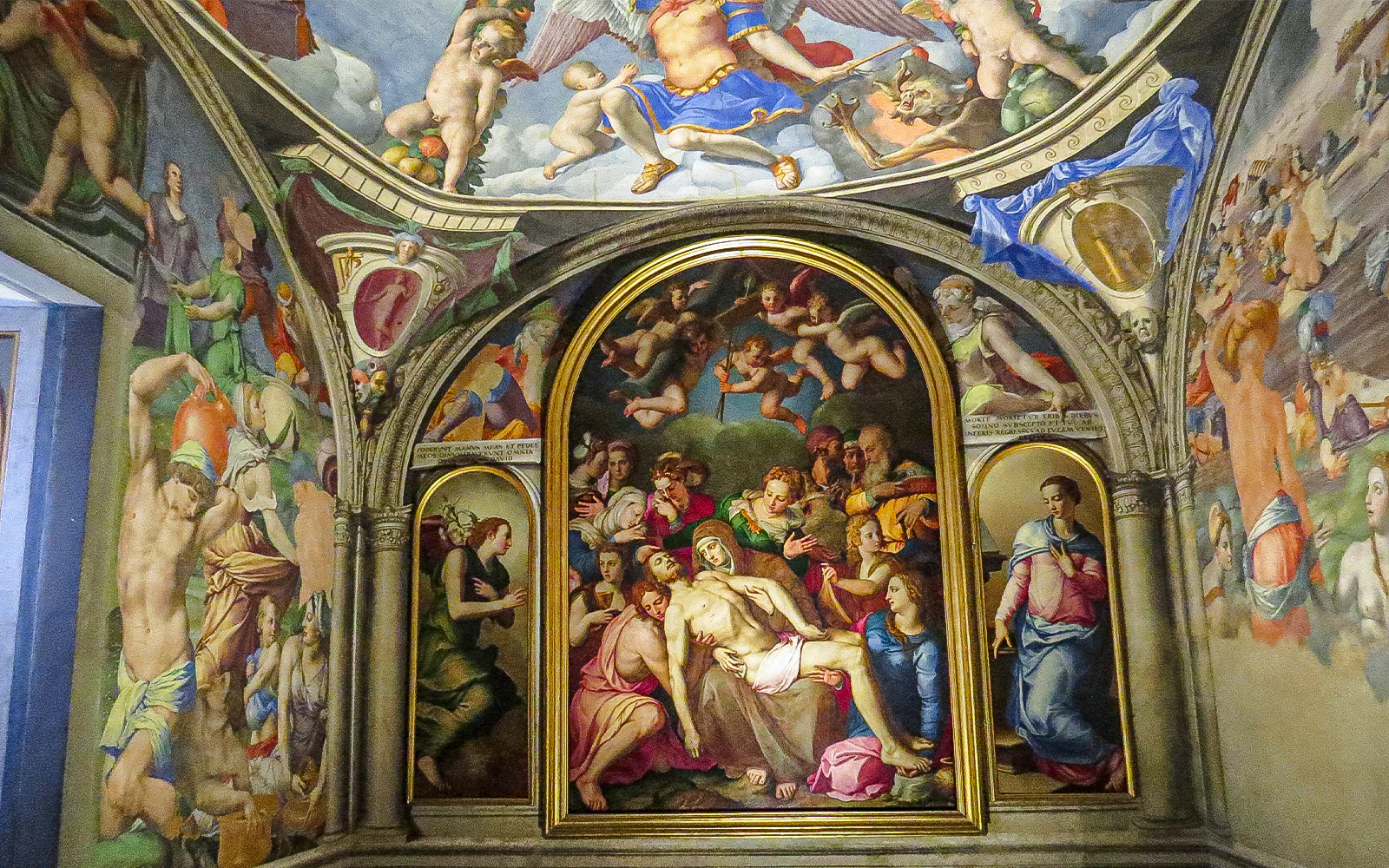
The Apartments of Duchess Eleonora of Toledo
These private quarters contain rooms dedicated to legendary historical women like Esther, Penelope, Gualdrada, and the Sabines. Her intimate Green Room (Sala Verde) is decorated with intricate naturalistic murals, and connects to her chapel featuring frescoes by Bronzino, including Crossing of the Red Sea.
The Apartments of the Elements
The private quarters of Cosimo I, include richly decorated rooms with frescoes by Vasari. Admire the ceiling fresco of Saturn Mutilating Uranus, and wall frescoes of Birth of Venus and the Forge of Vulcan. Discover oil paintings like Jupiter Fed by Nymphs and ebony cabinets with semi-precious inlays.
Terrace of Juno
Don’t miss this charming little chamber that once overlooked a columned loggia.
Hall of Geographical Maps (Sala delle Carte Geografiche)
Contains 53 painted maps by Ignazio Danti and Stefano Bonsignori (1564–1586), displaying 16th-century global geography. At its center is the Mappa Mundi, a large wooden rotating globe.
The Old Chancellery
The Old Chancellery houses an intriguing artifact - believed to be Dante Alighieri's death mask. It offers a tangible link to his legacy and the city's political history. This haunting artifact connects you to the revered and exiled poet's influence on literature and Florence's culture.
Beyond the levels of Palazzo Vecchio Museum
Venture into the secret passages or climb up Arnolfo Tower, additional experiences for the curious and adventurous.
Palazzo Vecchio floor maps
Ground floor
First floor
Second floor
How to get inside Palazzo Vecchio?
Pre-book your tickets and forgo the long lines to be captivated by the treasures that await within Palazzo Vecchio's magnificent walls.
Getting inside is a breeze. The main entrance to the palace is located in the Piazza della Signoria, right in the heart of Florence. As you approach the iconic fortress-like structure, you'll be greeted by the grandeur of its facade, beckoning you to step inside. For visitors with accessibility needs, Palazzo Vecchio offers accessible entrances and facilities. These entrances are equipped with ramps and elevators, ensuring a smooth and comfortable experience for all visitors.
Frequently asked questions about what's inside Palazzo Vecchio
In order to fully appreciate the stunning frescoes, sculptures, hidden rooms, and historical artifacts, we recommend you set aside a minimum of three hours.
Yes, there is a regularly updated schedule of special exhibits that last anywhere between a month to half a year. These can include specific collections, historic displays, and artistic themes.
Yes, restrooms are available for visitors inside Palazzo Vecchio. They are located near the ticket office and other designated visitor areas.
Don't miss the Salone dei Cinquecento, Hall of Geographical Maps, Tower of Arnolfo, and the exquisite Apartments of the Elements.
Many of the artworks inside Palazzo Vecchio are original, but some valuable pieces have been relocated to museums for preservation and replaced with high-quality replicas.
No, the Vasari Corridor is not accessible from Palazzo Vecchio. It connects the Uffizi Gallery to the Pitti Palace and is only accessible through guided tours arranged separately.
Yes, Palazzo Vecchio remains Florence’s City Hall and houses the offices of the mayor and city council. However, much of the building is open to the public as a museum.
Yes, certain areas, including administrative offices and private chambers, are restricted from public access. Some special rooms may be accessible through guided tours only.